

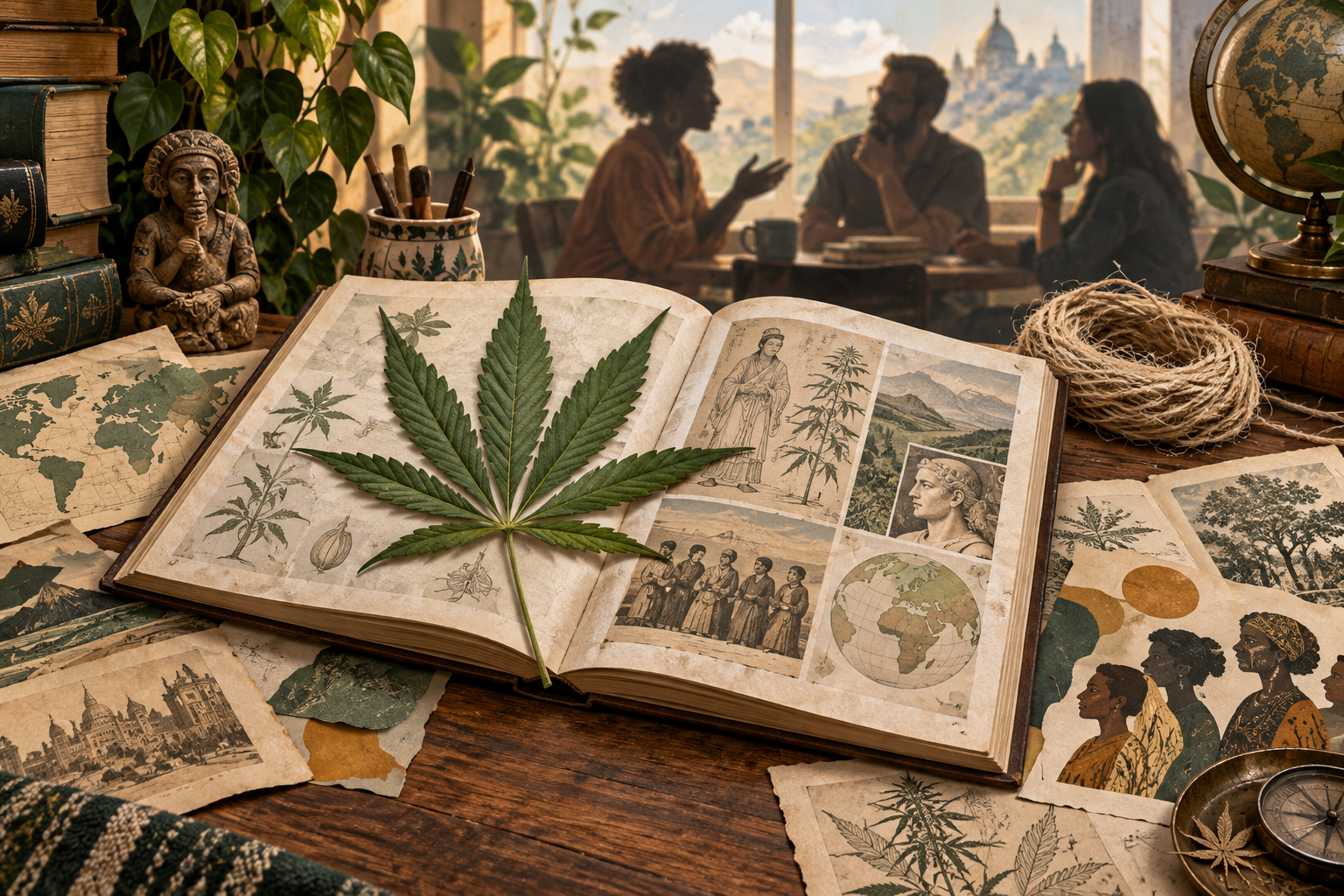
Ask a few people what comes to mind when they hear “cannabis culture,” and you might get very different answers: a favorite movie, a political debate, a family conversation, or a question about the plant itself.
That variety makes the subject interesting. Each answer offers a starting point, shaped by someone’s experiences and the stories they have encountered. Put those perspectives together, and there is plenty to explore: history, language, public opinion, and the everyday business of understanding one another.
For this first culture feature, let’s begin with a question: how much of our picture of cannabis comes from what we actually know?
A history with several threads
Cannabis has a long relationship with people. The Canadian Food Inspection Agency describes it as one of the oldest domesticated plants, historically cultivated for fiber, hempseed, and its psychoactive compounds. The agency also notes uncertainty about exactly where domestication began. Read the botanical and historical overview.
That history offers several ways into the subject. Someone interested in textiles might follow the story of hemp fiber. A reader interested in agriculture might look at how crops moved between regions. Another might investigate how particular communities described the plant and the meanings they attached to it.
Following those individual threads helps keep history specific. A practice associated with one place or period should be described in that setting. Calling something “ancient tradition” leaves a lot unanswered: whose tradition, documented by whom, and under what circumstances?
Those details are often where the best stories begin.
Public opinion has room for nuance
A January 2026 Pew Research Center survey found that 55% of U.S. adults favored legalizing marijuana for both medical and recreational use. Another 33% supported medical use only, while 11% opposed legalization altogether. The survey included 8,512 adults. See Pew’s findings and methodology.
The distinction between those responses matters. Someone can support one type of legal access and oppose another. A position on public policy also doesn’t tell us whether that person uses cannabis or wants to discuss it over dinner.
When talking about the subject, it helps to leave room for that complexity. Consider how differently a conversation might unfold if it starts with “What questions do you have?” Everyone gets a chance to explain what matters to them before anyone assigns them a side.
Give people more than a character role
Think about a fictional cannabis user you’ve seen on screen. What do you remember about the character besides cannabis? Their work, friendships, interests, or ambitions? Or does one familiar joke do most of the storytelling?
That’s a useful exercise in reading media. A memorable character can be entertaining while still giving us a very narrow picture of people. We can enjoy the performance and notice the limits of the portrait at the same time.
The same attention helps in real conversations. Curiosity about cannabis doesn’t require a particular personality, vocabulary, or point of view. People should have room to ask a basic question, express concern, disagree, or say the topic simply isn’t for them.
Keep curiosity in the conversation
A thoughtful cannabis discussion can start with something small: the history behind a word, the source of a widely repeated claim, or the difference between a personal story and a research finding.
Before sharing an interesting headline, follow its link. Look for the original source and its date. Notice whether the writer is describing an event, reporting an opinion, or making a prediction. Each deserves to be read on its own terms.
There is room for humor, disagreement, and uncertainty here. There is also room to change your mind after learning something new. Approaching cannabis culture with that kind of curiosity gives people something useful to share: a clearer understanding of the subject, and of each other.